Napoleon's Bicentenary: A Documentary of the Tomb Monument at Les Invalides
This documentary explores the bicentenary of Napoleon Bonaparte's death and the monumental tomb that serves as his final resting place in Paris. On 5 May 2021, exactly two hundred years after the emperor's death on the remote island of Saint Helena, French President Emmanuel Macron stood before the tomb beneath the golden dome of Les Invalides. The moment marked not celebration, but what Macron called "enlightened commemoration" - a careful acknowledgment of a figure who remains among France's most divisive historical personalities. This documentary examines the bicentenary commemorations that revealed how deeply Napoleon's legacy continues to shape French identity across Europe, even as it exposes the fault lines between those who see a military genius and modernizer, and those who remember an imperialist who re-established slavery. At the heart of these commemorations stood the tomb monument itself: a massive red quartzite sarcophagus that has drawn millions of visitors since Napoleon's remains were repatriated in 1840, and which underwent significant restoration in preparation for the bicentenary.
The Journey Home: From Saint Helena to Les Invalides
Napoleon died on 5 May 1821, exiled on the British-controlled island of Saint Helena in the South Atlantic. His body was initially buried in a simple grave at Sane Valley, marked only by a plain headstone. For nearly two decades, his remains stayed on that remote island, while in France, his legend grew. The July Monarchy, seeking to reconcile the nation's divided past, decided to repatriate the emperor's body. In 1840, a French expedition sailed to Saint Helena, exhumed Napoleon's coffin, and began the journey back to France.
The return became a national event. On 15 December 1840, Napoleon's remains arrived in Paris, where they were transferred to a funeral carriage drawn by sixteen black horses. The procession moved through the city's streets, past crowds estimated at hundreds of thousands, before reaching Les Invalides. There, the body was placed in the Chapel of Saint-Jérôme, where it remained for over two decades while the final tomb was constructed.
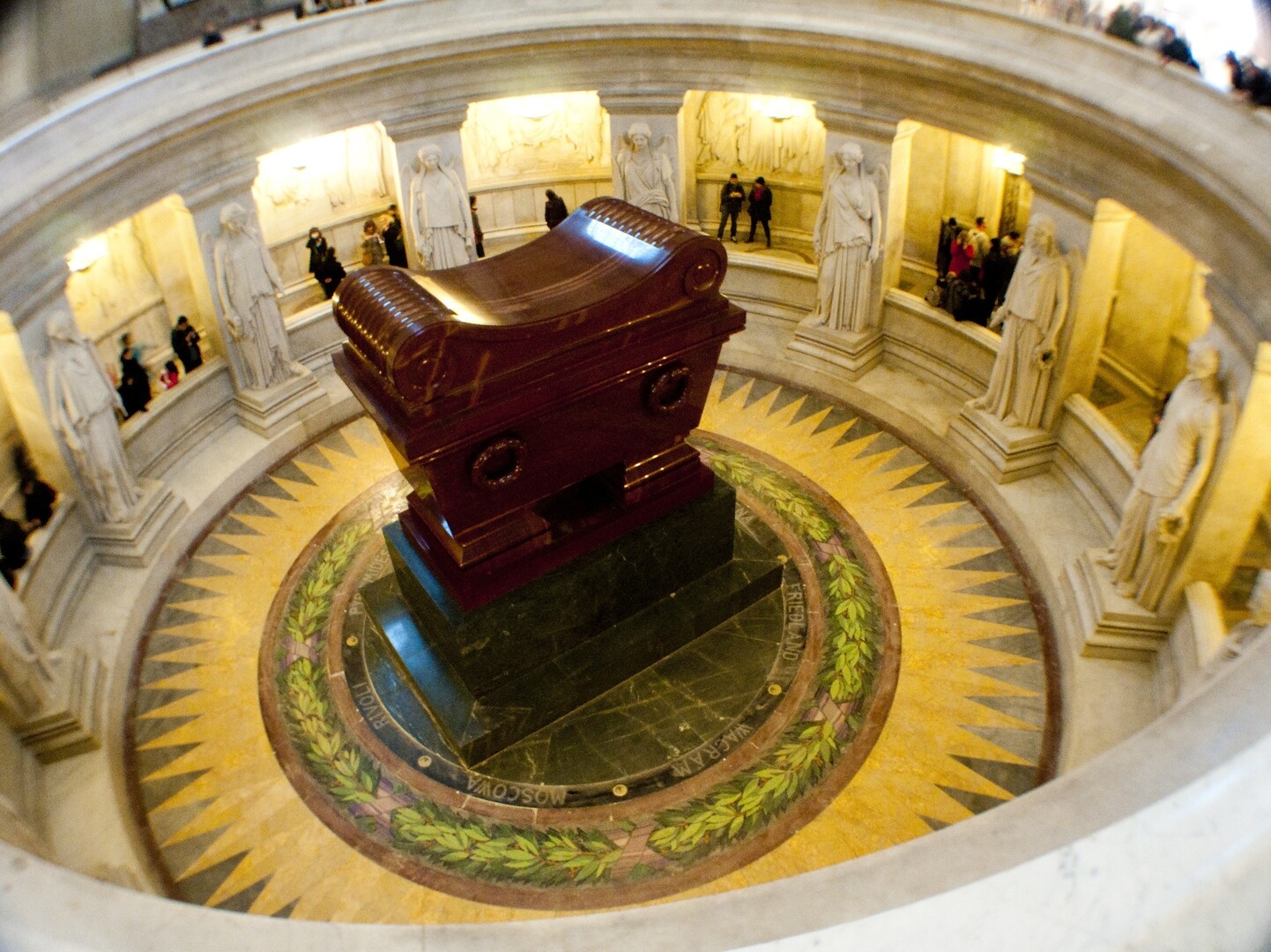
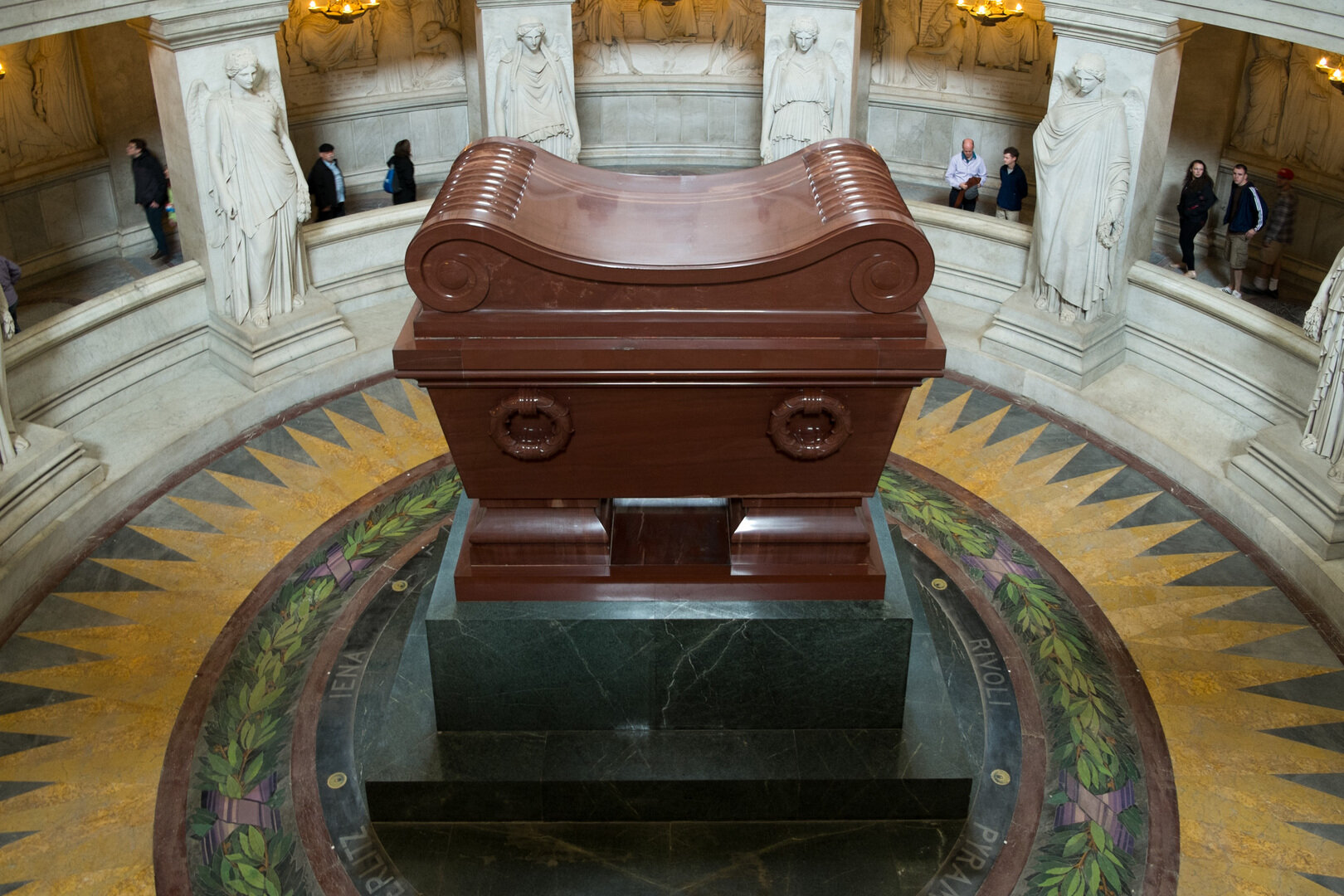
Architect Louis Visconti designed the monumental tomb that now occupies the center of the Dôme church. The sarcophagus, carved from red quartzite - a material chosen for its rarity and imperial associations - rests on a base of green granite. Six coffins encase Napoleon's remains: one of tinplate, one of mahogany, two of lead, one of ebony, and finally the outer sarcophagus. The design deliberately echoes ancient Roman imperial tombs, positioning Napoleon within a tradition of great rulers. The tomb was completed in 1861, and Napoleon's body was finally laid to rest in its current location on 2 April 1861.
Timeline of Napoleon's Final Resting Place:
- 5 May 1821 - Death on Saint Helena
- 9 May 1821 - Initial burial at Sane Valley, Saint Helena
- 1840 - Repatriation to France begins
- 15 December 1840 - Arrival in Paris
- 1861 - Final interment in current tomb at Les Invalides
- 2021 - Bicentenary commemorations and tomb restoration
Inside the Tomb: A Documentary Exploration of the Monument
This documentary now turns its focus inside the tomb monument itself. The Dôme des Invalides, designed by Jules Hardouin-Mansart and completed in 1706, stands as one of Paris's most recognizable landmarks and a significant monument in Europe. Its golden dome, rising 107 meters above the city, was originally intended to honor Louis XIV, but history redirected its purpose. Today, it serves as a national necropolis - a sacred space where France's greatest military leaders rest. The interior creates an atmosphere of solemn grandeur: light streams through the dome's oculus, illuminating the circular crypt below where Napoleon's tomb monument occupies center stage.
Inside the tomb monument, visitors enter through the main church, descending a circular staircase that leads to the crypt level. The tomb itself sits within a circular space, surrounded by twelve massive marble columns representing Napoleon's greatest victories across Europe. The red quartzite sarcophagus, measuring over 4 meters long and weighing 35 tons, rests on a pedestal of green granite from the Vosges mountains. Around the perimeter, bas-reliefs and inscriptions commemorate key moments in Napoleon's career, while statues of figures from his reign stand guard. Inside the monument, the design creates a sense of both intimacy and monumentality - you can walk completely around the tomb, viewing it from every angle, yet the scale emphasizes the historical weight of what lies within this European monument.
Inside the crypt, this documentary reveals that the space also contains the tombs of Napoleon's brothers - Joseph and Jérôme Bonaparte, both kings during the Empire - as well as other significant military figures. This arrangement transforms the space into a family mausoleum and a monument to an entire era. The restoration work completed for the bicentenary addressed damage to the laurel shield supporting the sarcophagus, cleaned the marble floors, and restored the tombs of Joseph and Jérôme, ensuring the entire monument reflects the dignity appropriate to a national monument in Europe.
The 2021 Bicentenary Documentary: Commemoration of a Monument Amid Controversy
This documentary chronicles how the bicentenary of Napoleon's death arrived at a moment of intense debate about historical memory in France and across Europe. The government's decision to commemorate the anniversary - announced by spokesman Gabriel Attal in March 2021 - immediately sparked controversy. Historians, politicians, and activists divided sharply. Some emphasized Napoleon's contributions: the Civil Code, administrative reforms, the Banque de France, and the lycée system that still structures French education. Others focused on the darker aspects: the re-establishment of slavery in 1802, wars that cost millions of lives across Europe, and the suppression of the First Republic.
This documentary records how President Macron's approach reflected this complexity. On 5 May 2021, he delivered a speech at the Institut de France - an institution Napoleon himself had established - before laying a wreath at the tomb monument. His words carefully balanced acknowledgment of achievements with recognition of failures. "Napoleon is a part of us," he said, describing the decision to restore slavery as a "betrayal" while also praising the emperor's role in shaping modern France. The ceremony was deliberately framed as "enlightened commemoration" rather than celebration - a distinction that attempted to honor historical significance without endorsing every aspect of Napoleon's legacy.
The controversy extended beyond official ceremonies. The Musée de l'Armée's exhibition "Napoléon n'est plus" (Napoleon is No More) explored the circumstances of Napoleon's death and how his image evolved posthumously. The Grande Halle de la Villette mounted a major exhibition featuring over 150 works, including a section on slavery created in partnership with the Fondation pour la Mémoire de l'Esclavage. This inclusion was deliberate - organizers recognized that any honest documentary or commemoration had to address the most painful aspects of Napoleon's rule. The exhibitions drew substantial attendance despite COVID-19 restrictions, suggesting public interest in engaging with this complex history documented across Europe.
"Commemorating is not celebrating Napoleon. Celebration is something else. It presupposes a commitment to the character as a whole. As a researcher, I don't have to celebrate Napoleon in particular, but on the other hand, I see no reason why he shouldn't be commemorated." - Jacques-Olivier Boudon, historian and president of the Institut Napoléon
Restoration Documentary: Preparing the Monument for the Bicentenary
This documentary documents the restoration efforts that preceded the bicentenary. In anticipation of the bicentenary, the Fondation Napoléon launched an appeal for donations in May 2019 to restore monuments at Les Invalides, with particular focus on Napoleon's tomb monument. The work addressed several critical issues: the laurel shield supporting the sarcophagus had been damaged by falling stones, the marble floors required cleaning and restoration, and the tombs of Joseph and Jérôme Bonaparte needed renovation. The goal was to complete all work in time for the "Saison Napoléon 2021" commemorations.
The fundraising campaign exceeded expectations. A total of €836,960 was raised from private individuals and companies, surpassing the initial target of €800,000. This extraordinary mobilization reflected the enduring fascination with Napoleon - even among those who might not consider themselves admirers, there was recognition that preserving this monument mattered to French cultural heritage and to Europe's historical record. The Musée de l'Armée and Fondation Napoléon noted that additional donations would support ongoing restoration work, ensuring the tomb monument and surrounding monuments remain in excellent condition for future generations.
The restoration work itself required careful coordination. The Dôme church functions as both a tourist attraction and an active place of worship, so work had to proceed without disrupting regular visitors or religious services. Conservators worked with specialized techniques to clean centuries of accumulated grime from marble surfaces, repair structural elements, and restore decorative details. The result, visible when the bicentenary ceremonies took place, was a space that honored both its historical significance and its role as a living monument to French military history - a monument that stands as one of Europe's most significant memorial sites.
Visiting Napoleon's Tomb: A Guide to Les Invalides
Les Invalides occupies a prominent position in the 7th arrondissement, easily accessible from central Paris. The complex includes not only the Dôme church containing Napoleon's tomb, but also the Musée de l'Armée - one of the world's finest military history museums. The nearest metro stations are Invalides (Lines 8 and 13), La Tour-Maubourg (Line 8), and Varenne (Line 13), all within a 5-minute walk. The site is also served by several bus lines, and the golden dome serves as a visible landmark from much of central Paris.
A visit to Napoleon's tomb typically begins in the main courtyard of Les Invalides, where you can see the building's impressive facade and understand the complex's original purpose as a military hospital and retirement home for veterans. From there, you enter the Dôme church, ascending to the main level before descending to the crypt where the tomb is located. The descent itself creates a sense of entering sacred space - moving from the light-filled church above into the more intimate, focused environment of the crypt.
Allow at least 1-2 hours to fully appreciate both the tomb and the surrounding military museum. The Musée de l'Armée contains extensive collections related to Napoleon, including his personal effects, uniforms, weapons, and documents. These artifacts provide context that enriches the experience of viewing the tomb itself. Many visitors find that understanding Napoleon's life and career makes the tomb visit more meaningful - you're not just seeing a monument, but engaging with a complex historical figure whose impact continues to resonate.
Practical Information:
- Opening hours: Daily 10:00-18:00 (April-October), 10:00-17:00 (November-March)
- Closed: January 1, May 1, November 1, December 25
- Combined ticket includes access to tomb and Musée de l'Armée
- Audio guides available in multiple languages
- Photography permitted (without flash in the crypt)
Bicentenary Documentary: Commemorations Across Europe
This documentary extends beyond France to document how the bicentenary resonated internationally across Europe. While the most significant ceremonies took place in France, commemorations occurred throughout Europe. On Saint Helena itself, where Napoleon died and was initially buried, commemorations included a ceremony at Longwood House - the residence where he spent his final years - and a mass at the emperor's chapel. These events were broadcast live online, allowing global audiences to participate in the commemorations documented in real-time. The island, which relies heavily on tourism related to Napoleon's exile, saw the bicentenary as an opportunity to promote its historical significance.
Across Europe, Belgium - site of Napoleon's final defeat at Waterloo - organized major exhibitions. The Gare de Liège-Guillemins hosted "Napoléon, au-delà du mythe" (Napoleon, Beyond the Myth), featuring 350 authentic pieces including Josephine's dress, Napoleon's outfits, and his campaign tent. The Waterloo Memorial presented "Napoléon: de Waterloo à Sainte-Hélène, la naissance de la légende" (Napoleon: From Waterloo to Saint Helena, the Birth of the Legend), focusing on the emperor's last years. These exhibitions reflected how different nations across Europe engage with Napoleon's legacy - for Belgium, he represents both the complexity of European history and a significant tourist attraction.
Throughout Europe, other countries also marked the occasion. Italy, where Napoleon left significant administrative and legal legacies, issued commemorative stamps and organized exhibitions. Switzerland's Arenenberg Museum presented an exhibition on Napoleon's final years. The global response demonstrated that Napoleon's impact extended far beyond France's borders across Europe, and that his memory continues to matter in places he once ruled or influenced. This documentary reveals how the bicentenary became, in effect, a moment for multiple nations across Europe to reflect on their own relationships with this complex historical figure and the monuments that commemorate him.
Documentary Conclusion: A Monument to Contradiction Across Europe
This documentary concludes by examining how visiting Napoleon's tomb monument means confronting the contradictions that define his legacy across Europe. Here lies a man who codified laws that still influence legal systems worldwide, yet also re-established slavery. A military strategist whose campaigns reshaped Europe, yet whose wars cost millions of lives. A figure who overthrew a republic to establish an empire, yet whose administrative reforms created institutions that endure. The tomb monument itself reflects these contradictions - it's both a monument to individual achievement and a reminder of the complex costs of ambition documented throughout Europe.
This documentary has shown how the 2021 bicentenary demonstrated that these contradictions remain unresolved in French public memory and across Europe. The debates that surrounded the commemorations - about whether to celebrate, commemorate, or ignore Napoleon - revealed a nation still wrestling with how to remember its past. The tomb monument at Les Invalides stands as a physical manifestation of this ongoing conversation documented in this exploration. It's not a simple shrine to heroism, nor a place of condemnation, but rather a space where visitors can engage with the full complexity of history.
This documentary reveals that for travelers, a visit to Napoleon's tomb monument offers more than historical sightseeing. It's an opportunity to witness how a nation grapples with difficult heritage, to see how architecture and ceremony can shape memory, and to understand that great historical figures rarely fit into simple categories. The bicentenary year, with all its controversies and commemorations documented here, showed that Napoleon's story continues to evolve - not because the facts change, but because each generation must decide what those facts mean. The tomb monument remains, as it has for over 160 years, a place where history and memory intersect, where the past speaks to the present, and where visitors can reflect on the enduring questions about power, legacy, and national identity across Europe - a story this documentary has sought to document and preserve.
Traveler's Questions
How do I get to Napoleon's tomb at Les Invalides?
Les Invalides is easily accessible by metro. Take Line 8 or 13 to Invalides station, or Line 8 to La Tour-Maubourg, or Line 13 to Varenne. All stations are within a 5-minute walk. The golden dome is visible from much of central Paris, making it easy to orient yourself. The complex is located in the 7th arrondissement, near the Seine and the Musée Rodin.
Do I need to book tickets in advance?
While advance booking isn't strictly required, it's recommended during peak tourist seasons (spring and summer) and on weekends. The combined ticket for the tomb and Musée de l'Armée can be purchased online or at the entrance. Booking ahead helps avoid queues and ensures you can visit at your preferred time. Guided tours often include skip-the-line access.
How long should I plan to spend at Les Invalides?
Allow 2-3 hours for a comprehensive visit. This gives you time to see Napoleon's tomb, explore the crypt, and visit the Musée de l'Armée, which contains extensive Napoleonic collections. If you're particularly interested in military history or want to see all the museum's collections, you could easily spend 4 hours. The tomb itself can be viewed in 30-45 minutes, but the surrounding context enriches the experience significantly.
What was the controversy surrounding the 2021 bicentenary?
The bicentenary sparked debate about whether France should commemorate Napoleon, given his re-establishment of slavery in 1802 and his role in overthrowing the First Republic. Some argued that commemorating meant celebrating, while others distinguished between commemoration (acknowledging historical significance) and celebration (endorsing all actions). President Macron's approach was to "commemorate, not celebrate," acknowledging both achievements and failures. The debate reflected broader questions about how nations should remember complex historical figures.
Is photography allowed inside the tomb?
Yes, photography is permitted throughout Les Invalides, including in the crypt containing Napoleon's tomb. However, flash photography is not allowed in the crypt area, as it can damage the marble and other materials. The lighting in the crypt is designed to create a solemn atmosphere, and natural light from the dome above provides sufficient illumination for photography without flash. Be respectful of other visitors and any religious services that may be taking place.
For personalized guidance, historical context, and seamless access to Napoleon's tomb and Les Invalides, contact our Tour Concierge at [email protected].