Notre-Dame Cathedral: Interior vs Exterior Architecture Compared
Notre-Dame de Paris stands as one of the finest examples of French Gothic architecture, a cathedral where the exterior's bold engineering innovations meet an interior designed to inspire awe through light and verticality. Built over nearly two centuries beginning in 1163, this masterpiece balances structural necessity with spiritual ambition. The exterior solves the problem of supporting massive stone walls and vast windows; the interior transforms those solutions into sacred space. Understanding how these two aspects work together reveals the genius of medieval builders - and explains why 12 million visitors arrived annually before the 2019 fire, drawn to experience both faces of this architectural triumph.
The Exterior: Engineering as Art
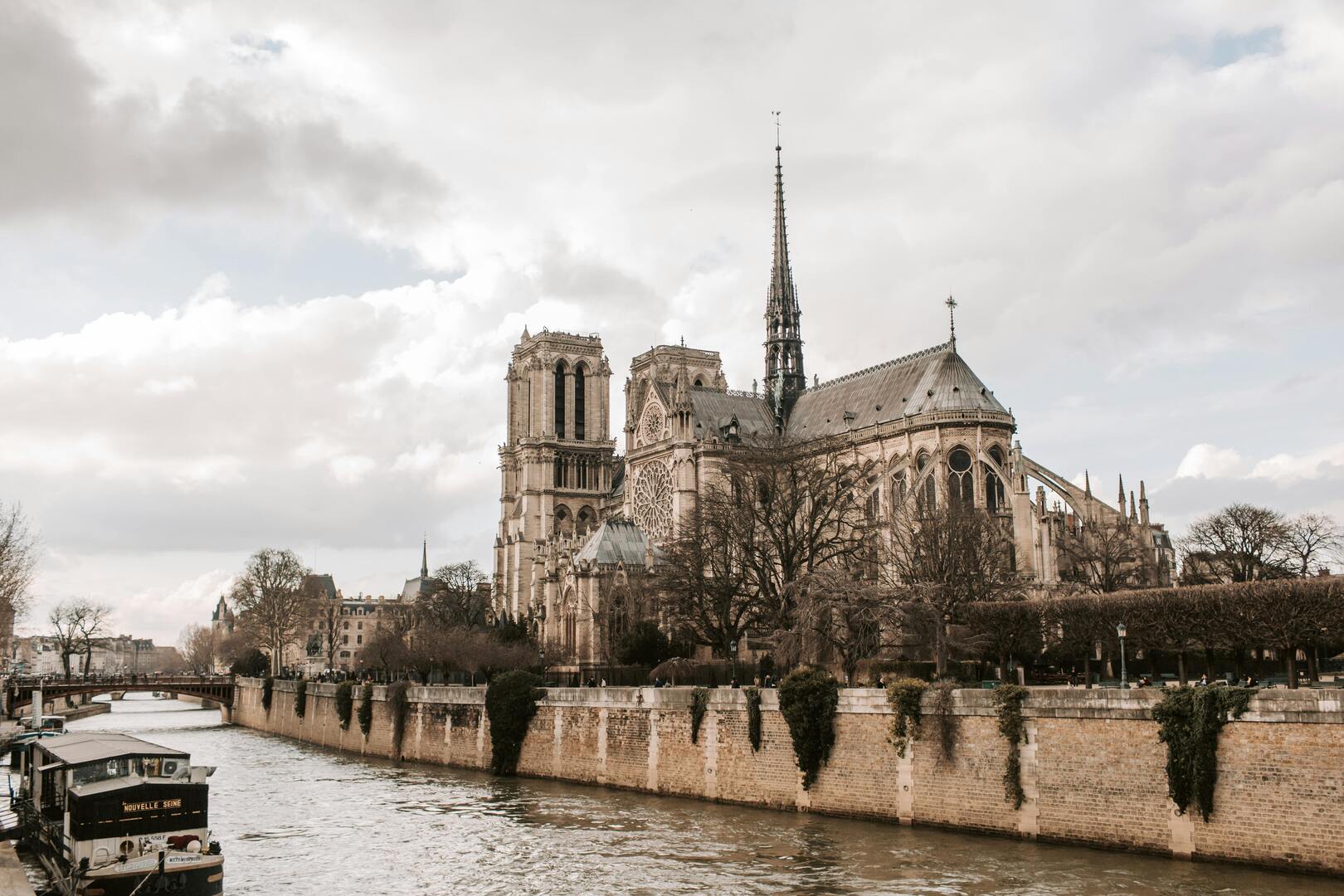
Notre-Dame's exterior represents a revolution in medieval construction. The architects who designed it between 1163 and 1345 faced a fundamental challenge: how to build higher walls with larger windows without the structure collapsing under its own weight. Their solutions - flying buttresses, pointed arches, and ribbed vaults - became the defining features of Gothic architecture.
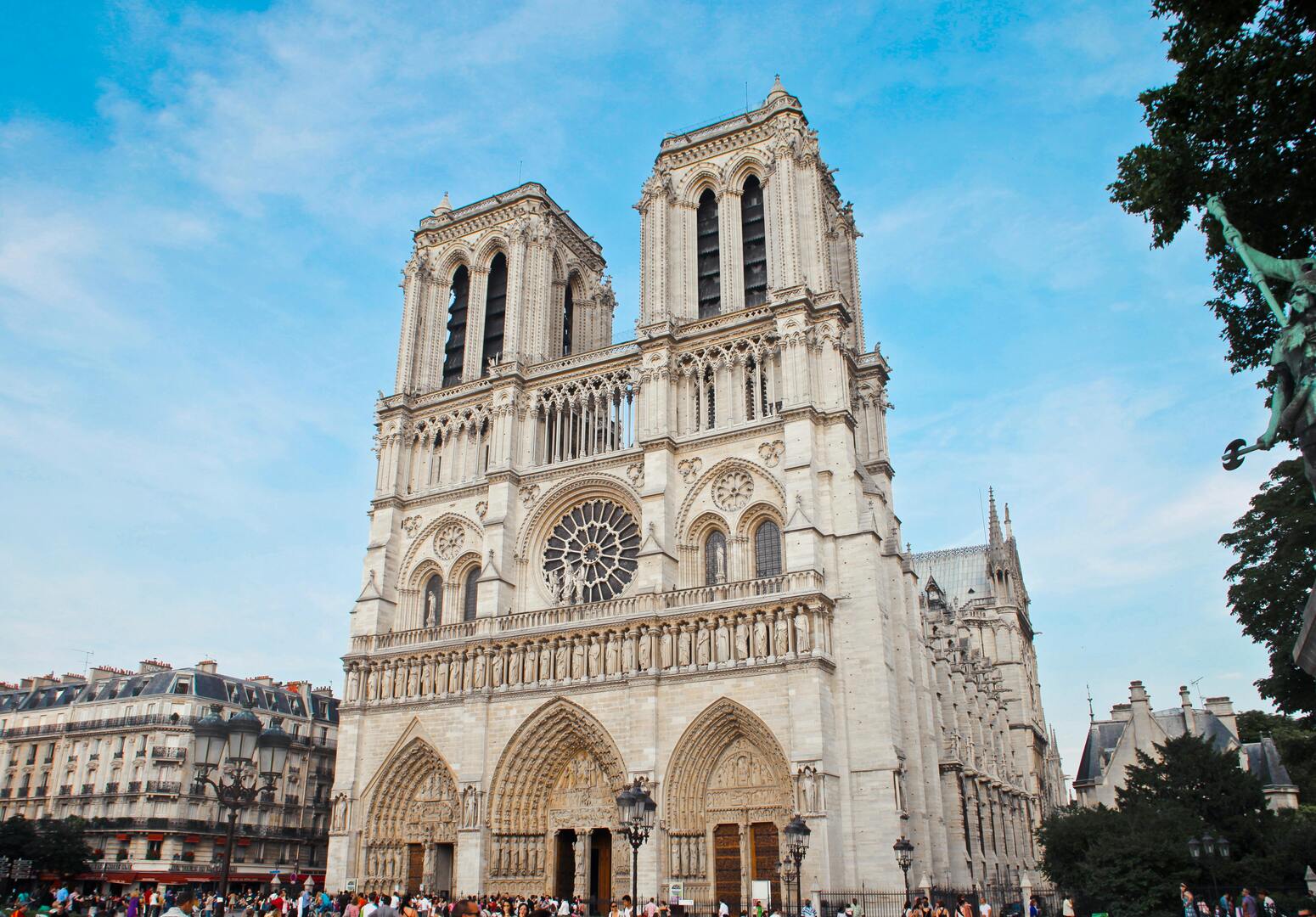
The western façade presents the cathedral's most recognizable face. Measuring 43.5 meters wide and 45 meters tall (69 meters including the towers), this "harmonic façade" achieves perfect symmetry through its tripartite design. Three portals occupy the lower level: the Portal of the Virgin on the left, the Portal of the Last Judgment at center, and the Portal of Saint Anne on the right. Above them, the Gallery of Kings displays 28 statues representing the kings of Judah - replacements for originals destroyed during the French Revolution.
The flying buttresses represent perhaps the most innovative exterior element. These external supports transfer the outward thrust of the roof and vaults away from the walls to massive stone piers. At Notre-Dame, the buttresses span up to 15 meters from the walls, allowing the interior walls to be thinner and more extensively pierced with windows. Art historian Andrew Tallon's laser scans confirmed that the buttresses were part of the original design - not later additions as some historians had theorized - and that the upper structure has not shifted "one smidgen in 800 years."
Key Exterior Features
- Flying Buttresses: 14 around the choir with 15-meter spans
- Two Bell Towers: 69 meters high, built 1220 - 1250
- Gargoyles: Functional rainspouts projecting water away from walls
- The Spire: 96 meters tall, reconstructed after 2019 fire
- Materials: Lutetian limestone from Parisian quarries, lead roof covering
The gargoyles serve both decorative and practical purposes. As rainwater drainage systems, they project water away from the stone walls, preventing erosion of the mortar. Their fantastical forms - monsters, demons, and mythical creatures - also carried theological meaning for medieval worshippers, representing the evil that threatens those who stray from church teachings. The chimeras on the Gallery of Chimeras, often confused with gargoyles, are purely decorative additions from Viollet-le-Duc's 19th-century restoration.
The Interior: Light and Transcendence
Step inside Notre-Dame and the exterior's structural logic transforms into spiritual experience. The nave rises 35 meters - the height of a 10-story building - creating a sense of vertical aspiration that lifts the eye and spirit upward. This effect was intentional: Gothic architects understood that soaring interior spaces could evoke the divine.
The interior is organized on three horizontal levels. The lowest level consists of massive arcades supported by round pillars with Corinthian capitals. Above these, galleries extend the full width of the side aisles, originally designed to accommodate choristers during services. The highest level features the clerestory windows, enlarged in the 13th century to flood the interior with light.
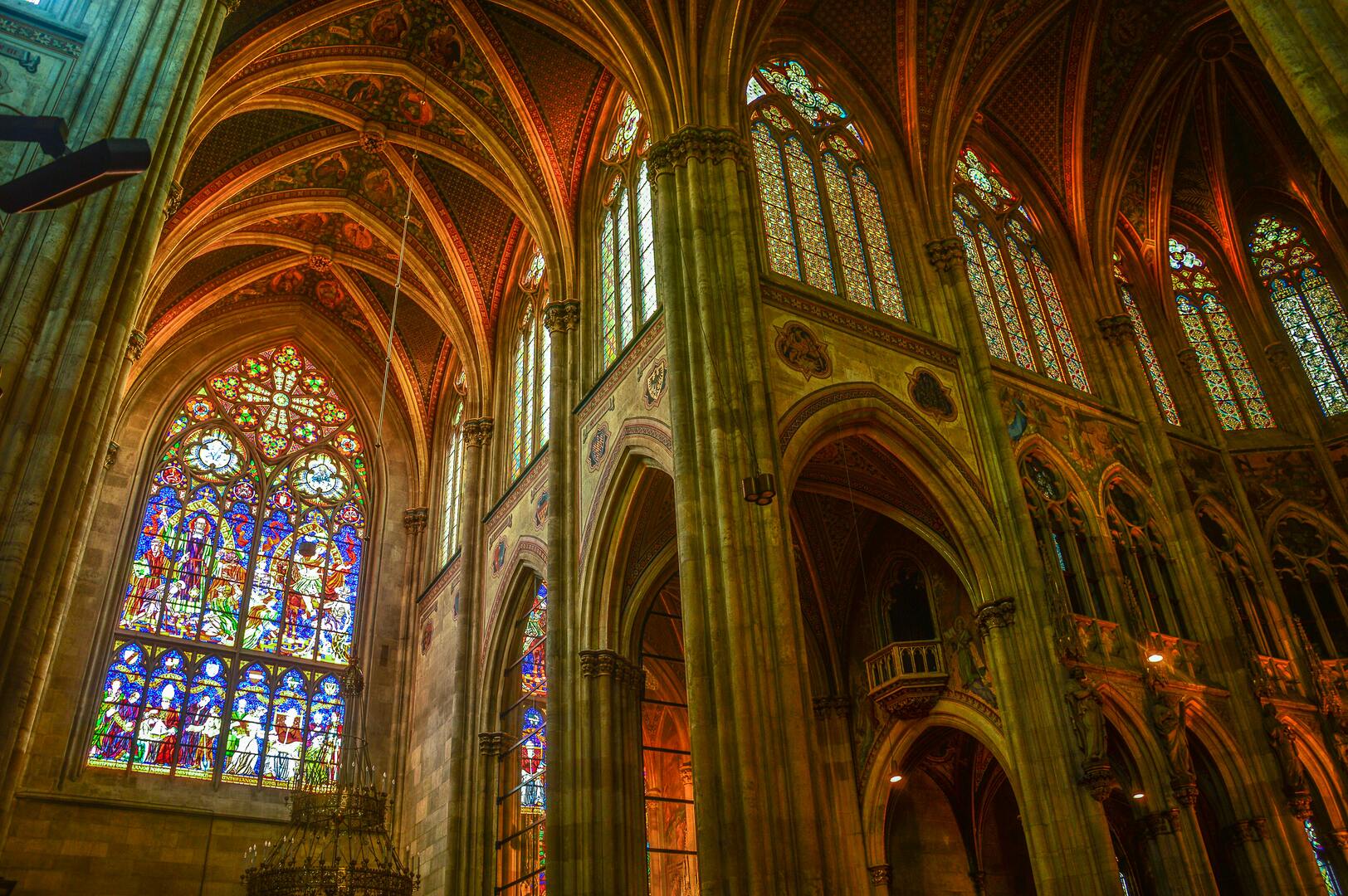
The nave consists of ten bays, each covered by sexpartite ribbed vaults - six-part vaulting that distributes weight more efficiently than earlier barrel vaults. This innovation, combined with the external flying buttresses, allowed the walls to be opened for the massive stained glass windows that define the interior's luminosity. The ribbed vault above the transept crossing represents an architectural feat of unprecedented dimensions.
"Where indeed, I ask, would they find two towers of such magnificence and perfection, so high, so large, so strong, clothed round about with such multiple varieties of ornaments?"
- Jean de Jandun, Tractatus de laudibus Parisius, 1323
Twenty-nine chapels ring the interior, added in the 13th century around the nave and choir. These radiating chapels provided wealthy families with dedicated spaces for memorial masses, each decorated with altars, paintings, statues, and sometimes tombs. The 2024 restoration revealed these chapel walls in their original blonde limestone color - a dramatic change from the centuries of accumulated soot that had darkened the stone.
Interior vs Exterior: A Comparison
The following table highlights the distinct characteristics and functions of Notre-Dame's interior and exterior architecture.
| Feature | Exterior | Interior |
|---|---|---|
| Primary Function | Structural support, weather protection | Worship space, spiritual experience |
| Key Innovation | Flying buttresses (15m spans) | Sexpartite ribbed vaults |
| Height Focus | Towers: 69 meters | Nave: 35 meters |
| Light Strategy | Thin walls enable large windows | Clerestory windows, rose windows |
| Decorative Elements | Gargoyles, chimeras, portal sculptures | Stained glass, paintings, choir screen |
| Materials | Hard limestone (façades), lead (roof) | Soft limestone (walls), marble (floor) |
| Rose Windows | Visible as circular stone tracery | Experienced as colored light displays |
| Construction Period | Façade: 1200 - 1250; Buttresses: 12th - 14th c. | Choir: 1163 - 1182; Nave: 1182 - 1208 |
The Rose Windows: Where Interior Meets Exterior
The three great rose windows exemplify how Notre-Dame's interior and exterior work in concert. From outside, they appear as intricate stone tracery - the west rose measuring 9.6 meters in diameter, while the north and south transept roses span 12.9 meters each. From inside, they transform into kaleidoscopes of colored light.
The north rose window, created around 1250, retains nearly all its original 13th-century glass - a remarkable survival. Its 80 panels depict Old Testament figures surrounding the Virgin and Child. The south rose, gifted by King Louis IX (Saint Louis) around 1260, features 94 medallions showing scenes from Christ's life, though much of its glass was restored in the 18th and 19th centuries. The west rose, the oldest but smallest, was entirely recreated in the 19th century after its original glass was lost.
Rose Window Dimensions:
- West Rose: 9.6 meters diameter, c. 1225 (glass replaced)
- North Rose: 12.9 meters diameter, c. 1250 (mostly original glass)
- South Rose: 12.9 meters diameter, c. 1260 (partially restored)
The 2019 Fire and Restoration
The fire of April 15, 2019, devastated Notre-Dame's roof and spire but also revealed new insights about the building's construction. The "forest" - the medieval oak roof framework - was destroyed, along with Viollet-le-Duc's 19th-century spire. However, the stone vaults largely held, protecting the interior from complete destruction. The three rose windows survived with minimal damage.
The restoration, completed in December 2024 at a cost of approximately €700 million, has transformed how visitors experience both interior and exterior. The interior stonework was cleaned using a latex paste technique that removed centuries of grime, revealing the original blonde limestone. The result has been controversial - some preservationists questioned whether the "ahistorical white interior" was appropriate - but restorers maintain the stone now displays its authentic 12th-century appearance.
The exterior received equally careful attention. The new spire, a faithful replica of Viollet-le-Duc's design, rises 96 meters above the crossing. A new gilded cockerel weathervane tops the spire, containing relics from the Crown of Thorns and saints Denis and Geneviève, along with the names of 2,000 people who contributed to the reconstruction.
Experiencing Both Dimensions
A visit to Notre-Dame rewards attention to both its exterior and interior. Begin outside, where the western façade rewards careful study of its sculptural programs - the Last Judgment tympanum alone contains dozens of figures depicting heaven, hell, and the weighing of souls. Walk around to the south side to appreciate the flying buttresses at their most dramatic, their stone arcs leaping from pier to wall.
Inside, allow time for your eyes to adjust. The contrast between the bright exterior and the filtered interior light is itself part of the medieval experience - a passage from the mundane world into sacred space. Note how the clerestory windows above create a crown of light, while the lower walls remain in relative shadow, drawing the eye upward.
The recently restored interior offers an experience unavailable for generations. The clean stonework reveals carved details long obscured by soot. Guillaume Bardet's new liturgical furniture - altar, tabernacle, and baptistery - represents the first major additions to the interior in over a century, blending contemporary design with Gothic sensibility.
"The interior elevations will regain their original colour, since the chapels and side aisles were very dirty. Of course it is not a white colour. The stone has a blonde colour, and the architects are very attentive to obtaining a patina which respects the centuries."
- Jean-Michel Guilemont, French Ministry of Culture
Practical Information
Notre-Dame reopened to visitors on December 7, 2024, following its restoration. Admission to the cathedral remains free, as it has been since the French state assumed ownership in 1905. However, advance reservations are strongly recommended, especially during peak periods. Entry to the towers, which offer close-up views of the chimeras and gargoyles along with panoramic vistas of Paris, requires a separate timed ticket.
The cathedral is located on the Île de la Cité in the heart of Paris. The nearest metro stations are Cité (Line 4) and Saint-Michel (Line 4 and RER B and C). Plan to spend at least 45 minutes to an hour inside, longer if you wish to attend a service or explore the Treasury, which houses the Crown of Thorns and other relics.
Key Dates in Notre-Dame's History:
- 1163 - Construction begins under Bishop Maurice de Sully
- 1182 - 1185 - Choir completed, high altar consecrated
- c. 1200 - Nave with flying buttresses completed
- 1250 - 1260 - North and south rose windows installed
- 1345 - Construction essentially complete
- 1844 - 1864 - Major restoration by Viollet-le-Duc
- April 15, 2019 - Fire destroys roof and spire
- December 7, 2024 - Cathedral reopens after restoration
Frequently Asked Questions
How tall is Notre-Dame Cathedral?
The nave rises 35 meters (115 feet) from floor to vault. The twin bell towers reach 69 meters (226 feet), while the reconstructed spire stands 96 meters (315 feet) above ground level.
What are the flying buttresses for?
Flying buttresses transfer the outward thrust of the roof and vaults to external piers, allowing the walls to be thinner and more extensively opened for windows. They also serve as part of the rainwater drainage system.
Did the rose windows survive the 2019 fire?
Yes, all three great rose windows survived largely intact. The north rose window, with its mostly original 13th-century glass, required only minor stabilization. The windows were protected by the stone vaults, which held despite the fire above.
Why does the interior look so different after the restoration?
Centuries of candle soot, incense residue, and pollution had darkened the limestone to a grayish-brown. The restoration cleaned the stone using a latex solution, revealing the original blonde color that medieval worshippers would have seen.
Is there an admission fee to enter Notre-Dame?
No. The cathedral is free to enter, though reservations are recommended. Separate tickets are required for the towers and Treasury. The French state owns the building and is responsible for its maintenance.
For guided tours of Notre-Dame and other Paris landmarks, contact our Tour Concierge at [email protected].